
Echoing throughout Colby College’s Coburn Library on April 2, 2026 are the voices of Craig Santos Perez, Professor Peckham, and myself as I moderate a conversation that meanders through the liminal spaces of documentary poetics, archival responsibility, and the ambiguous intimacies between personal memory and colonial record. A Chamoru poet from Guåhan with eyes bearing the serene look of someone who has lived many lifetimes of his ravaged homeland, Perez is a font of considered lucidity and unbridled generosity. Perez’s poetry embraces challenging questions with both rigor and accessible charm, bringing to life the pages of Habitat Threshold and the from unincorporated territory series in a style that marries critical sharpness with a deep humanity that can sometimes border on clairvoyance. Case in point, when Professor Peckham and I were workshopping our interview questions on a Maine-ly wintry day, we tried writing questions that would be pointed yet broad enough to allow for follow-ups to emerge. At times, Perez miraculously spoke as if he had read the questions already, intuiting the questions beneath our questions too. To be completely candid, I never expected my first literary interview to unfold with such ease, but perhaps that is because it’s extremely rare to sit across from a writer as generous as Craig Santos Perez. (Truly, who knew an interview experience could be this good? Perhaps this speaks volumes to Perez’s commitment to dialogue as a form of care more than any beginner’s luck on my part.)
True to The Colby Review’s mission to radically engage the contemporary vanguard and publish works that risks, questions, and imagines otherwise, this conversation with Perez reminded us that the most vital writing comes from a willingness to dwell in difficulty and to envision new forms of relation. I found this harder to articulate than I expected because Perez’s answers kept returning to the ethics of documentary practice, how one must “expose and critique” colonial archives while honoring the silences of family members who can’t speak of their trauma aloud. In a world where colonialism increasingly feels like a settled reality rather than an active dynamic to be contended with in the present-tense, Perez’s soothing and singed words intervene in the inevitable by reopening the record with critique and care. Sure, we can talk about documentary poetics techniques, but what Perez models is something closer to stewardship. He is drawn toward documents, memories, and silences that transcend erasure by respecting the boundaries of the unsayable, something you hear when he talks about letting his grandparents’ silences stand or not passing on the narratives of survivors he isn’t directly connected to. We also got to geek out about the exhilarating elasticity of these poetics, specifically how documentary fragments, family stories, ecological data, and canonical Western forms can coexist without compromising their individual integrity. Aesthetic eclecticism is not the point here, but it is clear from the juxtapositions in Perez’s work how different discourses can address each other without being incorporated—one of the craft-dependent delights of the work being its potential for surprising coincidence and satisfying simultaneity. When everything became simultaneous, the discussion started to make better sense and Perez could bring his sincerity and sensitivity to the real issues.
—Sama Fattah
Sama Fattah: You’re working in a tradition of documentary and archival poetics, which often relies on “found text,” bureaucratic writing, and historical records to ignite critique and reclamation. In poems like “from tidelands [latde/latte],” and throughout the from unincorporated territory series, you juxtapose text and images from historical documents and environmental surveys with language from social media posts, hymnals, and conversations with the living and dead, writing through and with a chorus of sources. How do you understand your responsibility to the documents and sources you “recycle” as well as those individual voices? Maybe what ethical limits do you set for yourself when working with colonial archives, and for your own family history or personal memory?
Craig Santos Perez: It kind of depends on the sources and documents. If I’m engaging with colonial archives, I definitely feel a responsibility to expose and critique them. Sometimes I want to also highlight these documents to members of my community who may not have time or energy to go into those archives or may not even be able to access them. I feel like I have a responsibility to kind of educate my community about some of those materials. When it comes to family histories, I feel like my responsibility is to honor them, whatever the sources might be. Some of my work in which I interview my grandparents is a way of creating our own family archive. I have showed my grandparents drafts of the poems and tried to seek their permission to share them publicly, in my work. Sometimes they grant me permission, sometimes they don’t. Or sometimes even when they’re telling me stories, they’ll tell me which parts they want included and which are off the record. And then there are even aspects of their stories which they’re not even willing to tell me. You know what I mean? Because it’s so traumatic that they can’t even say it out loud to me. So I try not to pressure them, to just let that silence be.
For personal memory, that depends, too. If my personal memories involve other people who may have passed away or I’m not able to seek permission from, I try to tread carefully and think about what they would want me to share and if they would want me to share it, or if I could find a way to share the memory and just include my part of it. That has been tricky at times. One example I shared at the talk yesterday was a memory I have of my cousin’s funeral, where I remembered it being a closed casket funeral. And so I didn’t even think to double-check that memory with other family members until after the book was published and one of my relatives told me, you know, it was actually open casket and they started describing it to me. There have been moments like that where I have misremembered the past.
Then there are other poems of what we might call public memory. In one of my poems, I talk about soldiers from Guam who were killed in various of the so-called wars on terror. Their deaths were often in the Guam newspaper, they were public events, on TV, various websites, including military websites. I really wrestled with including some of that information in my poem because even though I was related to a couple of the soldiers, they were not my immediate family. But I tried to include that aspect, those documents in a way that felt respectful and honoring of them in a way that I didn’t feel was happening in the public media.
SF: The colonial narrative is the more powerful one.
CSP: Exactly. So much of the representation of their deaths was to show our willing sacrifice to die for the nation, which of course is a colonial nation. I wanted to offer a critique of that representation.
I have another poem where I discuss the history of sexual abuse perpetuated by Catholic priests on Guam. And those stories of what happened to those boys who are now old men were captured in the newspapers. They were interviewed, they finally came forward to testify about what happened to them 40, 50 years ago. I had thought about including some of those stories in the poem, but again, I wasn’t related to any of these men. Even though their stories were in the public domain, it didn’t feel right to actually include their voices and stories. So instead I make it more of a mention, just document the history of what happened, facts, numbers, how many boys were molested. I did name the priests, but I decided not to include the victoms’ stories.
Those are just a few of the ethical questions I’ve been engaging with throughout my work, which I think a lot of documentary poets engage with.
Zach Peckham: Something that’s so interesting about documentary poetry techniques—and we’ve been talking about this from more of a critical standpoint, but shifting now to speak more in terms of craft—one of the things that can be so cool about this mode is that it gives the writer a technology for escaping the “I” a little bit. Of course the poet is arranging and is always in the poem even if there isn’t a traditional sense of “the poet’s voice” or “the speaker”—there is always the artist’s hand and a curatorial perspective, something that the poet is still doing in the arrangement even if they aren’t putting their own voice directly into the poem.
What is your relationship to that? How do you locate your self in documentary poetry when the materials are so external? How do you navigate the choice or the instinct to use “I” in specific moments? Because you do that every effectively.
CSP: That’s something I think about a lot. For me, I do like to have those moments where the speaker or the poet kind of breaks that fourth wall and enters into the documentary. One example that comes to mind is I have a poem about a bird, the Micronesian kingfisher. It’s a native bird of Guam that has become extirpated from the wild, so now only lives within zoos across the U.S. And I use a document of their species survival plan, and bring text from that document into the poem to describe how they are cared for in the zoos, how they are fed, raised, and so on. Then I bring in some personal memories of growing up in Guam, and learning about the bird in elementary school, drawing pictures of it and making fake nests. Later in life I actually got to see the bird for the first time at the San Diego Zoo. Throughout that poem I intersperse my own memories with this document. For me, whenever I do have a close personal connection to the topic I will try to bring in my voice, and I think about it as a kind of auto-documentary poetics. While I am documenting and curating in the poems, I’m still looking for those moments where I can bring my voice forward and comment on my own relationship to the subject and to the documents. I personally enjoy documentary poetry that does that because I feel like sometimes when the poet is completely distanced from the source, I don’t feel as much of an emotional connection to the work. I’m still interested and engaged with the work on other levels, whether it be historical, political, or intellectual. But I do appreciate those moments where I feel more emotional absorption into the text, as through the lyric voice, or a narrative I.
With the poem I mentioned about the Catholic Church, I was never an altar boy even though I grew up in the church, and so it made sense for me to have that be an omniscient narrator. I don’t bring my voice into that poem. The poem I mentioned about the soldiers, I do bring my voice into that because there was a time when I was going to join the military like many other people from Guam. I went through a whole process of being recruited by the Army, and just kind of weighing that decision. So I try to put myself and that experience into the context of the larger poem, if I do have that kind of personal connection that I can highlight.
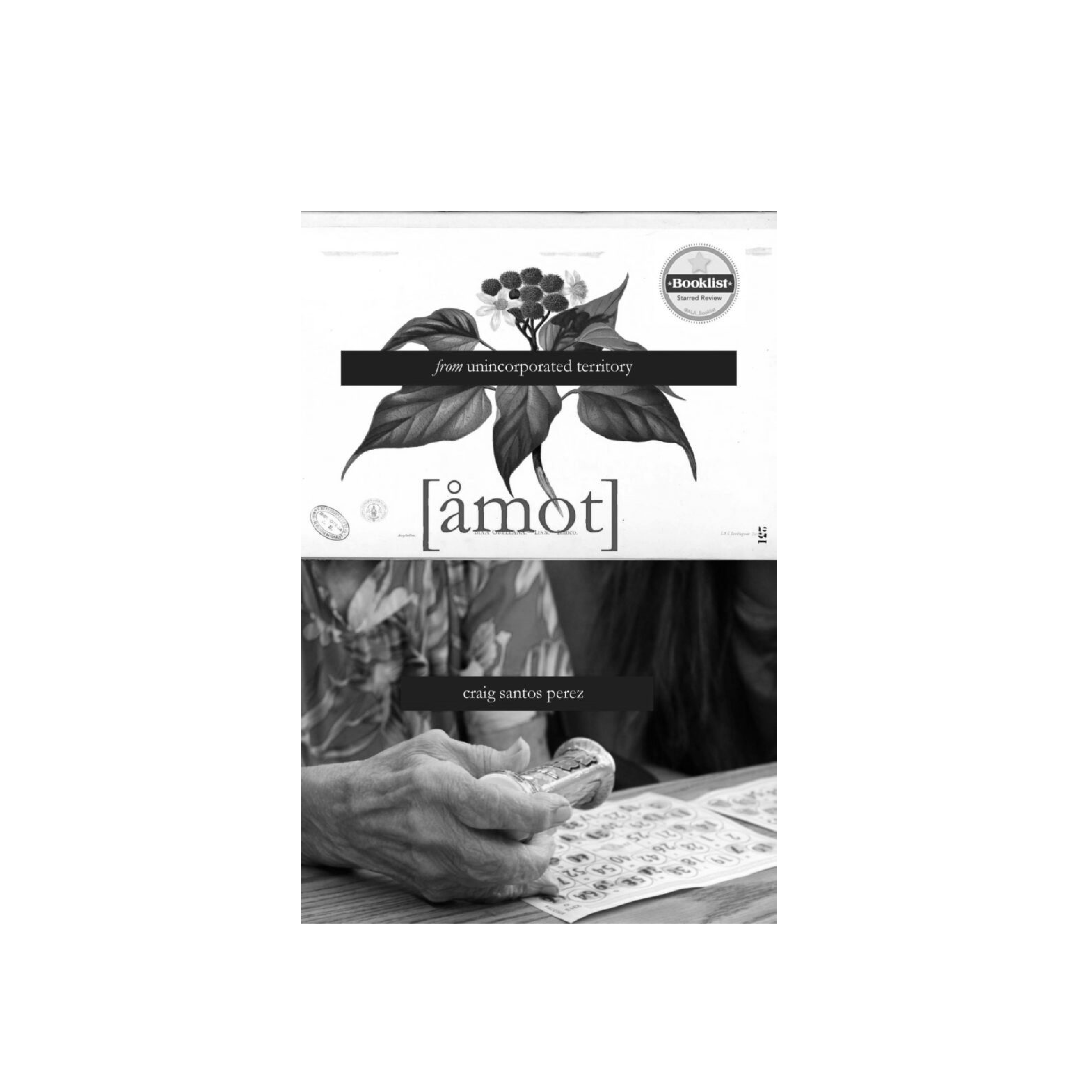
SF: The poems in from unincorporated territory often pit linguistic textures of live emotion against the cold posture of institutional speech, the unbodied historical record, and detached or even seemingly inconsequential facts. I’m thinking of sections of [åmot] that intermix your grandfather’s account of surviving U.S. military occupation of Guam with facts about the coconut rhinoceros beetle and nutrition facts on a bottle of store-bought coconut water, for example. And in Habitat Threshold, you combine intimate, touching moments of fatherhood such as your daughter’s teething or her birthday celebration with overwhelming aspects of global ecological degradation and violence. How do processes of radical—but maybe not so if we think about it—juxtaposition tracing personal thresholds against external thresholds of the Capitalocene and the sixth mass extinction activate your poetic imagination, or why are such thresholds so essential? How might this relate to your inclination to recycle traditional Western forms of poetry? In other words, what does revision or reappropriation offer in the face of collective loss and grief? Is reversioning the sonnet a way to deal with the toxic legacy the future will inherit?
CSP: Do you hear me, whoever’s listening on the other end of this interview? Damn. These are good questions. Thank you for engaging so deeply with my work across multiple books.
Yes, so radical juxtaposition. Thinking of from unincorporated territory [åmot], as well as the other books from that series, I’d never thought about it as radical juxtaposition, but I love that phrase. For me, in my work, I try to of course tell a story about Guam and Chamoru experiences, in all their complexity. Part of what that means to me is thinking about how our lives are intersected with history, politics, food, animals, ecology, and, you know, all the other phenomena that we engage with every day and shape who we are and where we come from. I’m interested in writing a poetry that can map out those interwoven threads and, as you say, juxtapose them together, to show what it means to, as Donna Haraway puts it, and I quote from my book, Habitat Threshold, too, stay in the trouble, stay with the trouble. And to not try to smooth out or simplify experience, but instead bring forth all these complexities, what ecologists call the web of life.
Part of that too is thinking not only about intersectionality but also generationality. Thinking about my relationship to my parents and grandparents, and how their experiences have shaped my own. And then thinking about my children and how the experience of their ancestors will shape their own identities and lives as they get older. About how all of our lives in the present are shaped by our environment, our ecologies, food we eat, what we’re surrounded with as well as our interactions with animals and and other people. Just difference in general. I’m trying to weave together all of those aspects of experience.
In terms of Habitat Threshold, it’s a bit of a different project that focuses more on eco-poetry. Much of my eco-poetry aims to articulate what people call “eco consciousness.” The idea that we should imagine the world as being interconnected, in that vast web of life or web of relations. In my poems, I try to connect, for example, the local to the global. The domestic to the societal, and the political, and the historical, and ecological. Thinking about poems as kind of a bridge to those interconnections, to find lines of relation across difference. That could be multi-species relations between people and animals, or just people from different places around the world, different cultures, religions, backgrounds, and so on. The hope is to make those thresholds that you talk about feel more intimate and crossable, as so many borders try to keep us separate.
Obviously we’re all interconnected. And of course, from the pandemic, we can see how we’re connected on even a bacterial or viral level. There’s a scholar, Stacy Alaimo, who describes this as transcorporeality. That we’re all connected across bodies. I try to embody those ideas in my poems. Obviously no single poem can do all these things. No single collection can do this perfectly, but I try to make each poem try to embody that interconnectivity that we all have within this larger ecological system.
ZP: For you, the willingness to acknowledge and cross into spaces of difference, to highlight that and be in that instability—is that what, for you, delineates “eco-poetics” from “nature poetry” or “nature writing?” In your mind, is there a meaningful distinction between these terms?
CSP: For sure. I kind of think of eco-poetry very broadly as an umbrella that can include nature poetry. But if I was establishing a difference, I would mostly center nature poetry as being articulated by British Romantic nature poetry. The idea that nature poetry is poetry that brings us into nature as an escape from urbanization and industrialization, and figures nature as a site of the sublime. Toward reconnection, to that feeling of being one with nature. So, very Romantic.
ZP: Very Transcendental.
CSP: Exactly. And then I see eco-poetry as, as you were saying, addressing issues like environmental justice, issues of interconnection, and also issues of, more recently, climate change. One poet who puts it very interestingly is Juliana Spahr. She describes nature poetry as poetry that depicts the beautiful bird in the tree and that moment of transcendence. Whereas eco-poetry is poetry that shows the loggers coming in to chop down the trees, and the birds losing their habitat, and so on.
That’s kind of a simple definition, but one that I think will highlight the difference.
ZP: This incidentally offers a little tunnel back into questions of recycling, and, if we want to be a little conceptual, of recycling Western forms—if eco-poetry could be a kind of intervention in the traditions of an Anglophone, Romantic view of nature which, as you say, is also informed by industrialization, and so in a certain sense recapitulates a legacy of domination via craft. The idea that nature is here for me to appreciate, like it’s recreational or something, with the human at the center, versus nature as something that I am part of and that affects me just as I affect it, us tangled up in the web. This is a hard question, but I’m interested in trying to connect an instinct to intervene in those traditional or canonical Western poetic forms and techniques with a parallel instinct to recycle or compost or biodegrade and ethically dispose of traditions that are not really serving us well in the present context. What do you think poetic techniques—and I hate these kinds of questions because I hate trying to argue for the “use” of poetry; the use of poetry is to be poetry—of revision, recycling, or reappropriation can offer in the face of catastrophe?
CSP: I love how you phrased all that. That was brilliant. Maybe I should start with how I started writing those poems. So in Habitat Threshold I have a series of poems I call “recyclings.” They basically started as imitations, but as I was imitating these canonical poems, I found myself thinking about them as recycling, partly because I was keeping the form of the original and often the syntax and grammar as well, but I was also putting in new content. I started doing those for this book because I had just read Naomi Klein’s This Changes Everything, and was doing a lot of research on climate change and thinking if climate change does change everything, then does it also change how we read poems from the past, especially poems that engage with nature in some way? I started to be like, okay, if I take these canonical poems, keep their form, but fill their forms with climate change-related content, how would that work and what would that teach me as an artist and as a person living in a time of climate change?
One of the first recyclings I did was of Pablo Neruda’s love sonnets, which if you’re familiar you know he uses metaphors and symbols from the natural world to represent the body, sex, desire, the erotic, and so on. I was curious in our time of climate change if we can use those same natural metaphors, changed by climate, and still be able to represent the same things. It created very strange poems, trying to make the Anthropocene sexy. I literally went crazy. I (re)wrote like probably 30 of his love sonnets, just recycled them. Instead of rolling hills that represent the curves of the body, I used hills that have been quarried or demolished from mining, etc. Wondering if that could represent another kind of desire. Another poem I recycled was Wallace Stevens’ “13 Ways of Looking at a Blackbird.”
ZP: I really wanted to ask you about that poem actually!
CSP: At the time, this was like 2015 or something, glaciers were trending. They were everywhere, and being from the Pacific I had never seen a glacier. I was looking at glaciers for the first time, watching these documentaries, seeing them on the news, seeing other artists engage with them. Stevens’ poem is all about looking at objects from different perspectives and seeing what we can learn from them as we kind of turn them over in our minds. I figured that would be an interesting poem to recycle and put glaciers into the form to try to see what we can see differently about glaciers.
ZP: That Stevens poem is so oblique too, it’s kind of funny to put it to that imposed purpose. I’ve taught that poem a bunch in poetry classes, usually in a unit on “After” poems and different techniques of collage and remix. I’m glad to hear you talk about the looking as the link between your poem and the one it’s after. When I teach your version, I put it in a comparative position but make sure to never qualify the intention, never explain the why too early, because that naturally coming up offers a way into the poem. Of course, why would someone do this, re-write or recycle a whole other poem? Is usually the question someone raises. And I have to tell students, “Well, I don’t know!” We have to read it to find out.
That leads to a lot of interesting conversations about technique and gesture. Because there’s the tone of the poem itself, but then what’s the tone of the remix? What is the feeling of the move? Is it a parody? Homage? Is it a cover, like a song? Is it satirical? This is maybe just a quality of poetry in general that at least I like to believe in, but I feel like another thing docupoetics and source-intervening techniques also offer is some ready tool to encounter to that kind of openness. We started with an idea about avoiding or expanding the I, but I think these poetics also alleviate some pressure on the poem to have an epiphany or confer easy knowledge. The epiphany is the poem is the knowledge. And your epiphany is probably different from mine anyway. That just feels exciting, embracing the sculptural qualities of poetry over communicative or classically didactic functions.
Sometimes I’ll have half the room read the Wallace Stevens poem, and half read yours, and then both halves read them aloud in unison and try to keep in sync with each other. Sometimes it works really well, sometimes it’s just a mess. But I think it’s always beautiful in its way, arcing toward this knot of questions we’ve had about sources and appropriating and recycling.
CSP: That’s wild! What a good idea!
One thing I love too about the Stevens poem is that so much of it is based on a kind of “Eastern” aesthetic, so-called. “Zen” aesthetics. I love haiku, personally. It’s all about also seeing deeply, a deep seeing into nature. Stevens’ poem kind of takes that practice of deep seeing and then applies it in these little haikus, 13 that he puts together. I wanted to see, also, if I could apply that haiku aesthetic to the glacier in order to see more deeply into it. To see the glaciers disappearing as well, because so much of haiku is attempting this timeless moment of nature, captured and unchanging. But then the glacier is melting.
ZP: There is something interesting about intervening in that tradition too, or in its own intervention, just insofar as there’s a pretty thick history of western white boys writing haiku. You know what I mean? Not to say there’s anything wrong with that inherently, but it is a bit of a poetry cliché. It’s certainly not Issa or Bashō’s fault that many of their imitators are often missing what’s actually in there. The form is quite alluring, after all. But I can’t help thinking about this context, of the appropriated haiku in U.S. poetics, as a form of Japonism, to put it in art history terms. Is there something funny, then, about the move itself? Taking the I that’s probably responsible for the melting glacier and pointing it at the glacier?
CSP: Absolutely! It’s very funny.
ZP: OK good, I’m glad we can agree on that. Haha. Let’s keep moving.
SF: I keep coming back to “Thanksgiving in the Anthropocene, 2015.” It’s so deft in its dramatic tonal shifts. Can you describe the dialectic you set up between the domesticity of the average American table and the unvarnished horror of the Anthropocene? When you use the repetitive structure of a secular prayer to subvert the commodity fetishism of the Thanksgiving meal, it seems like you’re working to disrupt the reader’s relationship with the gelatinous curves of cranberry sauce and the phosphate-laden discharge in Ajowite lakes. Would you say that this tonal shift from the performative gratitude to the stunning tank of systemic violence is some sort of decolonial intervention where the reader is encouraged to finally swallow the bones of genocide which underlies the empire of slaughter?
CSP: There you go. These questions are works of art themselves. I’m gonna keep them. These are amazing. Thank you.
So, the background on this poem is I literally wrote it after I ate Thanksgiving dinner in 2015. Just like, in a food coma. I started thinking, “Where did all this food come from? Why, and how did it get to my table?” Lying there, on my phone, I just started researching. I had of course done research before on plantation food systems and the so-called Plantationocene, but I had never actually just sat down and thought about it. So after I did all that research, I wanted to try to find a form for the poem that made sense. That’s when the prayer came into play. I used to teach a class on food writing, food literature, and I used this anthology—I forget the title at the moment—but it’s a collection of table blessings and food prayers from around the world. It’s one of my favorite anthologies. I wanted to kind of write in that form, as you put it, of performative gratitude. But of course then, the tonal shifts kind of embody those shifts between the local and the global in our food system. I wanted to create those shifts throughout where we could have the moment of gratitude and obliviousness, and then break that with, as you put it, the stunning tank of systemic violence. I’m definitely seeking to disrupt the reader’s relationship to these foods, to the familiar. There’s part of me that literally wanted to ruin the reader’s appetite. And obviously I ruined my own appetite too, in a way. It maybe alleviated aspects of the food coma. But I don’t want to write eco-poetry that romanticizes or excuses my own participation, my own complicity in these violences.
Throughout the book, I try to hold myself to account and reckon with my own complicity and my own behaviors in everyday life that contribute to this violence, and how my own privilege is founded on the disprivilege of so many others. To me, that’s, again, about staying in the trouble, and capturing, again, those complexities in which we are all entangled. To be honest about my own subjectivity and positionality. I’m not trying to critique all of you who are eating Thanksgiving, but pointing to myself and to the fact that I am engaged with this as well. And what are we gonna do about it?
ZP: You’re pointing to a quality of literature that we probably all know on some level, but I think really bears emphasis. Which is that, yes, poetry can be about beauty, reading can be relaxing, art can be therapeutic. But it’s also really necessary that it be unpalatable too. And uncomfortable. Maybe even actively creates or revels in discomfort. That’s not always what is marketable, right? This is just a part of why literature, poetry especially, remains such a marginal art in our culture. Yet that marginality itself is sometimes necessary, too.
This makes me want to ask you a question about small press. You’ve been with Omnidawn for so long, a legendary small press publisher, and it’s remarkable that you have had such a long relationship with them. That’s something that isn’t super common in publishing—especially among larger publishers who emphasize the blockbuster artists—but is something that the small press maybe makes uniquely possible between an author and their publisher. This long lasting relationship that is not about selling really well in a given quarter, but about building a legacy of books, something that takes years and even decades. This gives some material credence to the idea of the small press as a kind of necessarily paraeconomic cultural force, the place for not just fun or weird but also uncomfortable literature that is so necessary to a healthy literary ecosystem. So I am just curious how you think about yourself in relation to that, if you think about yourself as a small press author, and just generally your relationship to the small press. What does being a small press author mean to you?
CSP: A lot of people don’t know this, but the founder of Omnidawn, Rusty Morrison, was one of my teachers during my MFA at the University of San Francisco. She introduced me to the world of small press publishing. The Bay Area is one of the birthplaces of the small press revolution, and I got really immersed in that as a young writer. I also ended up interning for Omnidawn when I was an MFA student, so I got to see how they operate, and how they struggle, got to work on their submissions and contests and book design and marketing. To me, it just felt like family. During that point in time, this was in like 2005, there was not a lot of interest, in the publishing world, or at least poetry publishing, in really experimental or avant-garde poetry, especially avant-garde poetry by writers of color. I had a hard time getting my work published, partly because of my style, but also because of what I wrote about. I had big press publishers tell me that there would be no market. They had never heard of Guam before. They wouldn’t be able to sell it. Feeling marginalized from the mainstream, and then obviously coming from a very marginalized place, I was very grateful that my work was embraced by small presses.
I’ve been working with Omnidawn, with Rusty as my editor, for a long time now. She is the best reader of my work. She’s the only person I share my work with in terms of revisions and editing, and she’s made my work better over the decades. So I have not wanted to leave to go to a bigger press, where I could make more money. I would lose that feeling of family and that relationship with my longtime editor. I also want to continue honoring my Bay Area roots.
Even though today there’s been a movement toward more diverse books, more experimental writers winning big awards and getting book contracts, I still haven’t been interested in taking that route. I want to stay true to the small press, the avant-garde, the counterculture that I grew up in as a writer.
ZP: It makes sense to me there’s a permanent animosity to experimental or confrontational—I don’t even necessarily mean tonally, but just, you know—literature that’s trying to do something that’s hard and that is marginalized or on behalf of the marginalized. Of course this stuff has a hard time being assimilated into a larger cultural mechanism. I don’t want to suggest that it can’t be or shouldn’t be, and that if it was then that would be bad or it wouldn’t help, though I’m skeptical that it would help. Some stuff does have to live in a slightly removed, slightly outsider position, so that it can be unbeholden to power in certain ways.
I’m trying to think about that in a way that is positive and generative, amid all of the difficulties that the small press continually faces. We talk about small press publishing so much in our class, it’s good to try to make these connections, make sense of the struggle.
SF: I also come from a region that has suffered through continuous military conflicts, occupation, and the lasting effects of government brutality, and the present day fight to tell their historical accounts as accurately as possible. I’m really interested in hearing more about your perspective on writing toward futures that are not just defined by these wounds. Do you see yourself, especially in the climate future poems and Habitat Threshold or the more forward-looking, tongue-in-cheek and instructional poems of [åmot], imagining a future in which survival and care are generative rather than reactions to harm?
CSP: That’s a great question. Thank you for sharing that about the region you come from. For me, writing about those wounds that you talk about is very difficult and engaging with those violent histories definitely has taken a toll on my own mental health, and just my own imagination of the world. It’s very taxing.
SM: It is. You can’t imagine another alternative. It’s very, very hard. And some people will literally call you delusional, which is not fun.
CSP: Mm-hmm.
At this point I’ve published seven books, probably like 700 pages of published poetry, and there are still so many more wounds to write about, from just my own culture. It can be very depressing, and there are times where I stop writing and I’m just, like, weeping and there’s just so much grief. It does help me to also write poems in which, as you say, I can try to imagine a future that is more based on care and about thriving.
One poem that comes to mind just thinking that word care is a poem in Habitat Threshold. I think it’s just called “Care,” if I remember. A while ago we had an event, this is when I was living in Hawai’i, in solidarity with the Syrian people. This was during the height of the Syrian refugee crisis, so-called. I wrote this poem for that event, and it was all about trying to make connections across difference and across distance. The poem ends thinking about the Syrian parents who are trying to carry their children to safety, and the poem ends with the lines, “Will drowning be the last lullaby of the sea, or will we carry each other towards the horizon of care?”
I started thinking about care as a horizon. As a place that we need to carry each other toward, to imagine a future in which we can carry each other towards a land without war. A land of peace. If we can imagine that horizon of care, then maybe we can imagine it into existence. I feel the same way about my from unincorporated territory series. If we could imagine a future for my people and my homeland that is decolonized and demilitarized and is or will become a place of abundance as opposed to a place of extinction, a place of peace as opposed to a place of militarism and war, then maybe we could begin healing those wounds and generating places of care and of love and what in environmentalism we call hope spots. Places of hope and of survival.
So thank you for this question. This is a very deep question and something I haven’t thought about much in terms of the emotional impact of writing about such difficult topics, and the importance of that.
There’s a radical juxtaposition here as well, right? Imagining those horizons of care and those hope spots that will be places of refuge for all of us.
Craig Santos Perez is an Indigenous Chamoru from the Pacific Island of Guåhan (Guam). He is the co-editor of six anthologies; the author of poetry collections including Habitat Threshold and his ongoing “from unincorporated territory series”; and the author of the monograph, Navigating Chamoru Poetry: Indigeneity, Aesthetics, and Decolonization. Perez has received the National Book Award for Poetry, American Book Award, Pen Center USA/Poetry Society of America Literary Prize, Hawai’i Literary Arts Council Award, Nautilus Book Award, and the George Garrett Award for Outstanding Community Service in Literature from the Associated Writing Programs. In spring of 2026, he served as Colby College’s Center for the Arts and Humanities Islands Distinguished Fellow.
Sama Fattah is a student at Colby College and an editor of The Colby Review.
Zach Peckham teaches at Colby College and is Faculty Editor of The Colby Review.